|


| Professional |
| Classes |
| Hobbies |
| Useful Links |

- Send me email (click here and delete my initials at end).
- My Homepage: http://www.math.uconn.edu/~troby
- Office: MONT 239; Phone: 860-486-8385
- Office hours: via Zoom by appointment at: https://nexus.uconn.edu/secure_per/schedule1.php?stser=3498 I am happy to schedule appointments via Nexus (link above) or by email, which I check frequently.
Email is generally the best way to reach me. I try to block out most mornings for research and writing (or it languishes).
In Spring 2024 I have no teaching duties. In Summer Session 1 (28 May–28 June 2024) I will teach a 5-week compressed version of Math 2210Q (Applied Linear Algebra).
I am currently a tenured full professor in the Department of Mathematics at the University of Connecticut in Storrs (a very safe place to live though others may be better), where I arrived in Fall 2005. My main research interests are in algebraic and enumerative combinatorics, and I've also done a good deal of work in educational outreach. From Fall 2005 through Fall 2012, I also directed the Quantitative Learning Center (Q Center) as 50% of my appointment. Here is a partial list of UConn acronyms (some now obsolete) that I've needed to learn since I arrived. How many can you name without looking?
Before coming to UConn I held faculty positions in the math departments of the following academic institutions:
- California State University Hayward (which changed its name to "Cal State East Bay" in January 2005);
- the University of Wisconsin;
- Reed College; and
- the University of Tokyo (as a JSPS postdoctoral fellow).
I was a student at:
- MIT, where I earned a Ph.D. in algebraic combinatorics under Richard Stanley;
- Swarthmore College, where I essentially double-majored in math and ancient Greek;
- Kenwood Academy, a public high school on the South side of Chicago;
- Bret Harte School (Chicago); and
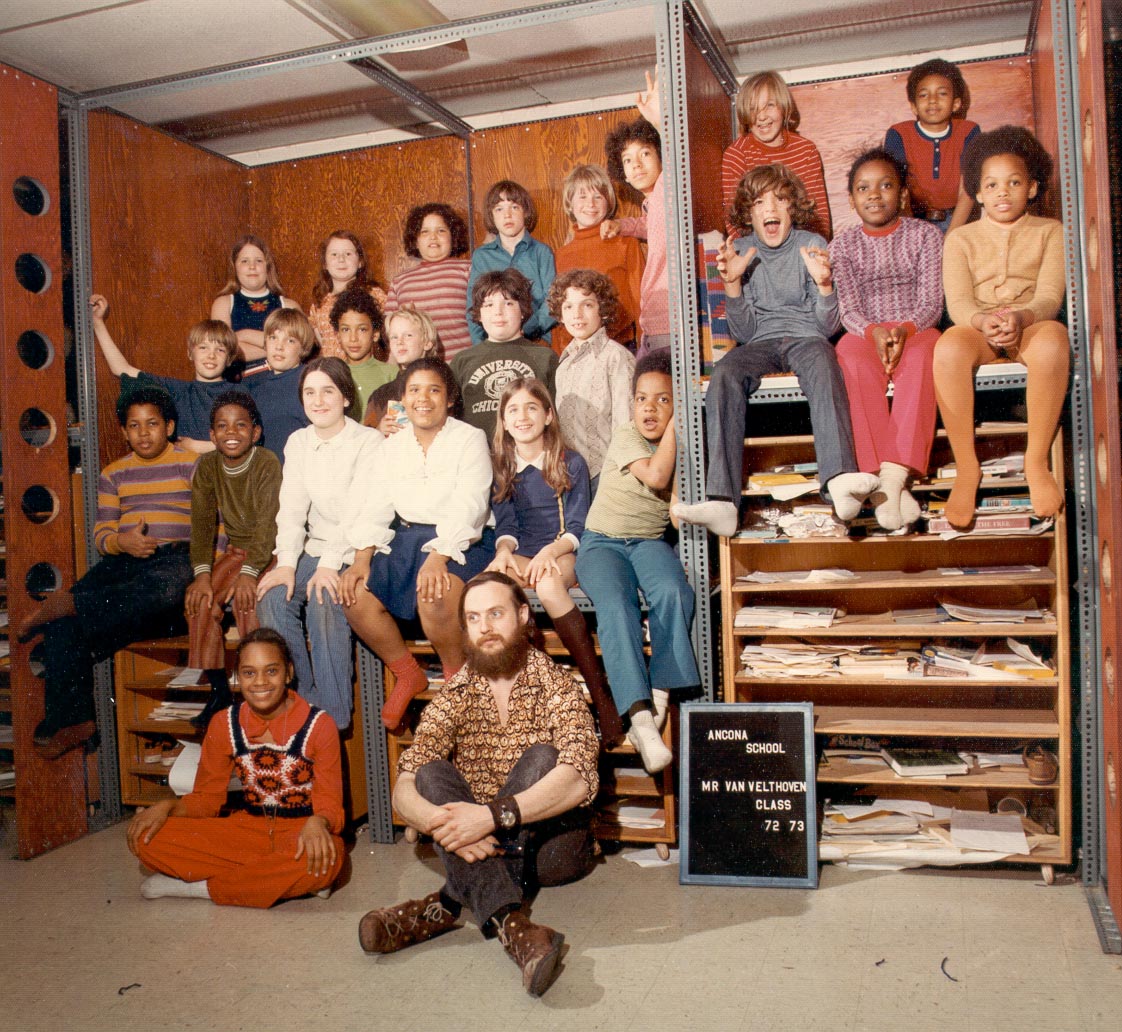
- Ancona Montessori School (Chicago) Click here for an Ancona picture. Can you pick me out?
Along the way I directed, taught in, and/or participated in a number of summer programs, including
- Faculty at MathPath, for advanced students aged 10–14 with a strong interest in math (3 summers).
- Founding and directing ACCLAIM (Alameda County Collaborative for Learning and Instruction in Mathematics), a large grant-funded professional development program for K‒12 teachers (5 summers).
- Founding head counselor, then recitation instructor at ProMYS (PROgram in Mathematics for Young Scientists) at Boston University (4 summers);
- Senior staff at HCSSiM (Hampshire College Summer Studies in Mathematics) (2 summers);
- Northfield Mount Hermon Summer School (1 summer); and
- Student, counselor, and head counselor at The Arnold Ross math program at Ohio State University (5 summers).
|